
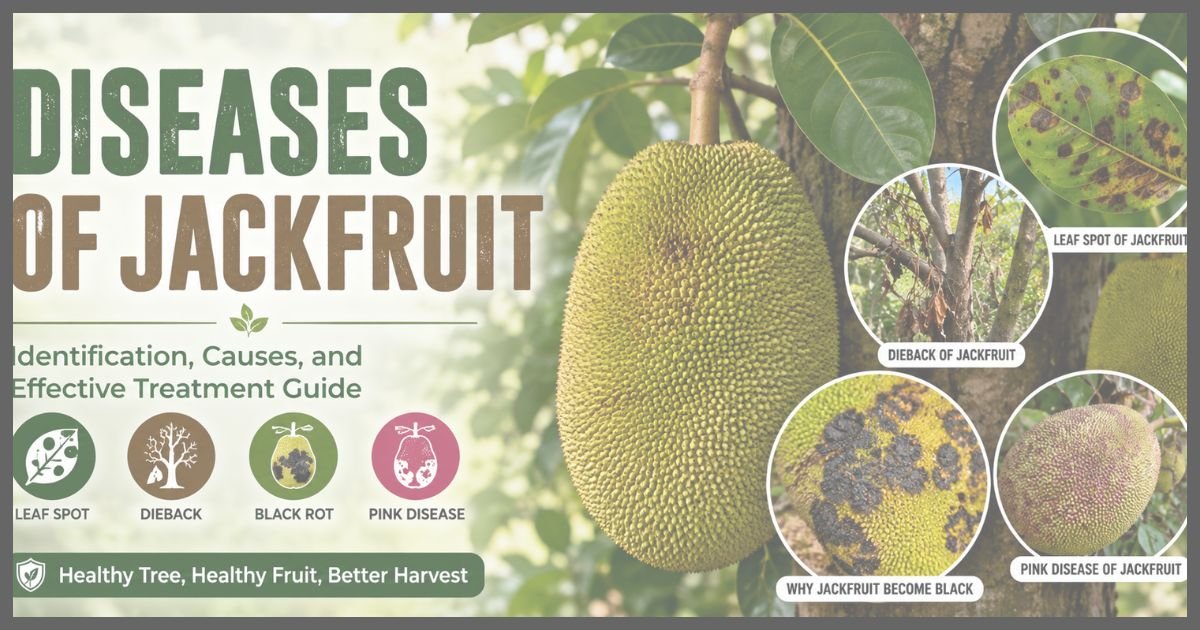
Jackfruit (Artocarpus heterophyllus) is a valuable tropical fruit tree grown for its large nutritious fruits. However, diseases of jackfruit can seriously reduce tree health and yield. This article covers the most common jackfruit diseases their symptoms, causes, and control strategies so growers can protect their trees. We discuss leaf spot of jackfruit, dieback of jackfruit, pink disease of jackfruit, fruit rots, and other disorders. You will learn how to recognize symptoms (brown spots, bark discoloration, black mold, etc.), identify causal agents, and apply effective treatments.
Integrated management practices including pruning, sanitation, fungicides, and resistant varieties are also covered. For example, Florida’s Extension notes that jackfruit seldom has many disease problems; the main issues are Rhizopus rot of the fruit and occasional leaf spots. With proper care and timely intervention, most jackfruit diseases can be managed to keep trees healthy and productive.
Jackfruit diseases may be fungal, bacterial, or cultural. Common pathogens include fungi (e.g. Botryodiplodia, Pestalotiopsis, Corticium/Erythricium, Rhizopus, Phytophthora, Colletotrichum) and bacteria (e.g. Pantoea stewartii causing bronzing). Each disease shows distinct signs. For instance, jackfruit dieback (caused by Botryodiplodia theobromae) leads to branch tip wilting and brown foliage, while leaf spot appears as small white or red spots with dark margins on leaves. Pink disease produces pinkish fungal crust on branches and defoliation. Rhizopus fruit rot causes black fuzzy mold on young fruit. We will examine each major disease category in detail, then cover management and prevention.
Jackfruit Dieback (Branch Dieback):
Causes & Symptoms: Jackfruit dieback is most often caused by the fungus Botryodiplodia theobromae. Infected branches show discoloration and darkening of bark from the tip downward, and young twigs wither and brown starting at the base. Affected leaves turn brown with margins rolling upward. As the infection advances, the twig or branch dries out, often oozing gum, and eventually dies and falls. Internally, the wood turns reddish-brown. Sometimes secondary pests (shoot borers) invade cankered branches. This disease is more common in humid, warm climates. In summary, dieback symptoms include wilting of new shoots and blackened branch tips, spreading inward through the tree.
Management: Effective treatment involves removing diseased wood and applying fungicides. Farmers should prune out infected twigs and branches, cutting well below the diseased area. After pruning, spray the cuts and surrounding foliage with a protective fungicide. Recommended sprays include Carbendazim (0.1%) or Thiophanate-methyl and Chlorothalonil (0.2%). These are broad-spectrum fungicides effective against Botryodiplodia. Also control stem-boring insects that can enter wounds and exacerbate dieback. Maintaining good tree vigor by adequate watering and nutrition helps the tree resist infection. In plantations, avoid mechanical injuries to limbs (e.g. from equipment) which can be entry points for dieback fungi. According to TNAU extension, reducing humidity through canopy thinning and removing leaf litter can slow disease spread.
Key Points: Dieback causes branch tips to brown and die, moving down the limb. Prune out affected wood and spray Carbendazim or Chlorothalonil on cuts. Control borers to reduce stress on branches.
Rhizopus Fruit Rot (Soft Rot of Jackfruit)
Causes & Symptoms: One of the most common fruit diseases of jackfruit is soft rot caused by Rhizopus species, especially Rhizopus artocarpi. This fungus attacks flowers and young fruit in warm, humid conditions. Initially, small watery brown spots appear on petals or developing fruit. These expand quickly, and a fuzzy white to gray mycelium emerges, later becoming covered with dense black sporangia (spores). The entire fruit or inflorescence can rot and drop prematurely. The infected flesh becomes black, shrunken and mummified. Rhizopus rot often follows rain or stormy weather during bloom. As CTAHR (Hawaii) notes, Rhizopus rot can cause total crop loss when warm, wet conditions coincide with flowering.
Management: Preventing Rhizopus rot focuses on sanitation and fungicides. Since the fungus thrives in high humidity, avoid overhead irrigation during flowering. Remove and destroy any blighted flowers or fruit immediately to interrupt the disease cycle. For young fruit, regular protective sprays of broad-spectrum fungicides help. For example, apply Mancozeb or Copper Oxychloride (0.25%) at 3-week intervals during flowering and early fruit development (e.g. January–March in India). Good orchard sanitation (removing dropped fruit) also reduces inoculum.
Note that there are no known resistant jackfruit varieties, so timely sprays and hygiene are critical. If fruit are harvested, handle carefully to avoid bruises which can invite Rhizopus. If harvested fruit show rot symptoms, remove them from storage promptly. In general, Rhizopus rot is managed by keeping the orchard dry and treated with fungicides as recommended.
Phytophthora and Root Rots
Causes & Symptoms: Jackfruit can suffer from root and collar rots caused by water molds like Phytophthora palmivora and related species. These pathogens thrive in waterlogged soil and enter through wounds. On fruit, Phytophthora causes a soft rot: water-soaked lesions appear on wounded or thin-skinned areas within 48–72 hours, enlarging into light brown, sunken spots with white mycelium at the edges. The fruit flesh around the spot turns mushy. In addition, Phytophthora can infect the tree trunk at ground level, causing gummosis or foot rot. The bark becomes dark and water-soaked, exuding gum. Trees may wilt and die if collar rot girdles the trunk. Unlike Rhizopus (which mainly infects young fruit/flowers), Phytophthora often enters via roots or trunk.
Management: Control of Phytophthora involves improving drainage and applying fungicides. Avoid soil flooding – jackfruit dislikes saturated soils. Ensure good drainage around the trunk. Chemically, spraying Benomyl (1 g/L) or metalaxyl-based fungicides on the trunk base and soil can suppress Phytophthora. For fruit protection, Bordeaux mixture (1%) or Captan sprays before rainy season can reduce attacks. Remove and destroy infected fruit and roots. Use raised beds or mulches to keep roots dry. If gummosis occurs, scraping away infected bark and painting with Bordeaux paste or similar can help. Overall, prevent root rot by avoiding water stress and treating soil with oomycete fungicides as needed.
Leaf Spot of Jackfruit
Causes & Symptoms: Several fungi cause leaf spot of jackfruit, leading to unsightly blemishes and premature leaf drop. Common culprits include Phyllosticta artocarpina, Pestalotiopsis species, and Colletotrichum spp. Symptoms vary by pathogen, but typically small round spots appear on leaves. For example, Pestalotiopsis causes white or grey spots with dark margins, while Phyllosticta or Colletotrichum cause reddish-brown centers with dark edges. Mature spots may show gray centers and black fruiting bodies. When numerous, the spots coalesce and leaves yellow and drop. Leaf spot does not usually kill the tree but can weaken it by reducing photosynthesis.
Management: Good sanitation and fungicides are effective. Remove heavily infected leaves and do not compost them. Avoid overhead watering which spreads spores. Fungicidal sprays of Carbendazim (0.05–0.1%) or Thiophanate-methyl at 2–3 week intervals can control leaf spot. Bordeaux mixture (copper sulfate + lime, 1%) is also effective against many leaf fungi. In organic orchards, a lime-sulfur spray can help. In trials, biocontrols like Trichoderma harzianum have shown promise: a Trichoderma-based biofungicide significantly reduced jackfruit leaf spot in experiments. Ensure good air circulation by pruning dense canopy – dry foliage more quickly and reduce humidity. Monitor the orchard regularly, since early treatment when only a few spots appear is easier than after severe infection.
Pink Disease of Jackfruit
Causes & Symptoms: Pink disease (also called pink blight) in jackfruit is caused by the fungus Corticium salmonicolor (formerly Corticium salmonicolor or Botryobasidium salmonicolor). It is named for the pinkish powdery fungal growth that appears on infected wood. Early symptoms are subtle: young twigs may develop a pink to salmon-colored coating over the bark. Under this growth, the bark decays. Infected branches often show dieback and the attached leaves drop prematurely, even though the fungus itself remains on shaded bark surfaces. Pink crusts form primarily on lower, shaded sides of branches and twigs, and eventually the bark splits and peels off. The disease is more common in wet, humid climates.
Management: Control centers on sanitation and protective treatments. Immediately prune out infected branches, cutting well below the diseased tissue. Dispose of or burn pruned material; do not leave it on the ground. After cutting, paint the exposed ends with Bordeaux paste or 1% copper oxychloride paste to kill any remaining mycelia. There is no effective foliar spray for pink disease, so pruning is key. Keeping trees healthy (avoiding overcrowding, improving air flow) helps limit spread.
Copper sprays on adjacent healthy bark may provide some protection, but care is needed with fruit-bearing trees. Some growers also apply a dilute Bordeaux spray over the whole tree in the rainy season as a preventative. Because Corticium can survive in soil and on prunings, thorough orchard hygiene is important.
Jackfruit-Bronzing (Bacterial Bronzing)
Causes & Symptoms: A newly recognized disease in jackfruit is jackfruit-bronzing, caused by the bacterium Pantoea stewartii subsp. stewartii. First reported in the Philippines (2014) and later in Malaysia and Mexico, this disease affects the inside of the fruit. Affected jackfruits show rusty specks and yellowish to reddish-orange discoloration in the fruit pulp and rag (the inner rind). The fruit flesh browns unevenly, which is termed a “bronzing” symptom.
This reduces fruit quality and market value. The bacterium infects through insect wounds (especially stem-borer damage). Since it’s new, information is limited, but it appears more aggressive on high-sugar varieties. No specific control is established; growers should remove and destroy infected fruits and practice strict sanitation. Monitoring for stem borer pests (which can carry the bacteria) is also recommended.
Other Diseases and Disorders
- Anthracnose (Colletotrichum spp.): Although not always highlighted in extension guides, anthracnose can occur in jackfruit. It causes dark sunken spots on leaves, twigs, flowers, or fruit, often with pink-orange spore masses. Severe infections lead to defoliation and fruit rot. Management is similar to fruit rot: remove affected parts and apply broad-spectrum fungicides.
- Citrus Pythium or Black Root Rot: Some Florida grower reports mention black root rot (caused by Thielaviopsis) on nursery jackfruit, causing reduced vigor. Avoid waterlogged soils to prevent this.
- Algal Leaf Spot: Rarely, a greenish-grey film (Cephaleuros algae) can appear on leaves or stems. It usually causes minor spots; control with copper sprays if severe.
- Sooty Mold: This is not a disease, but a fungus growing on honeydew from insects like mealybugs or scales. It leaves a black “dusting” on leaves and fruit. Control the insects (e.g., with neem oil) to eliminate sooty mold growth.
- Nutritional Disorders: While not pathogens, nutrient deficiencies (e.g. potassium) can cause leaf yellowing that may mimic disease. Soil tests and balanced fertilization help avoid these issues.
Symptoms and Diagnosis
Recognizing disease symptoms early is crucial. Common signs to look for include:
- Leaf discoloration or spots: Yellow, white, or brown spots with defined borders often indicate leaf-spot pathogens.
- Branch dieback: Twigs that turn brown from the tip and die back signal Botryodiplodia infection.
- Bark lesions or gums: Dark, sunken bark or gummy ooze at branch bases suggests Phytophthora collar rot.
- Fruit lesions: Soft, watery spots on young fruit, later black and fuzzy, indicate Rhizopus rot. Brown, sunken spots with orange spore masses suggest anthracnose.
- Pink growth: Powdery pink encrustations on twigs/branches is classic for pink disease.
- General decline: Wilting, leaf drop, or branch dieback can result from root rot or severe disease pressure.
Whenever uncertain, growers can send samples to a plant disease diagnostic lab. It’s also good practice to note the environmental conditions: e.g. flooding, extreme rain, or insect damage which often precede fungal disease outbreaks.
Integrated Disease Management:
Effective control of jackfruit diseases relies on an integrated approach combining cultural, biological, and chemical methods:
- Sanitation: Regularly remove diseased fruit, flowers, and leaves. Prune out and destroy infected branches (especially for dieback and pink disease). Keep the area under trees free of debris to eliminate fungal reservoirs.
- Cultural Practices: Ensure proper spacing and pruning to promote airflow and sunlight in the canopy, which helps foliage dry faster. Avoid overhead irrigation; instead use ground drip watering. Mulch trees to retain moisture but keep mulch a few inches from the trunk. Maintain balanced nutrition and avoid excessive nitrogen, which can make foliage tender and disease-prone.
- Resistant Varieties: Plant disease-resistant or tolerant cultivars when available. Most commercial jackfruit varieties have not been bred specifically for disease resistance, but local selections may show varying tolerance. Research in Asia is ongoing to identify resistant strains, especially for fruit rot and bronzing.
- Biological Control: Trichoderma spp. and other beneficial microbes can suppress soil-borne fungi. For instance, a Trichoderma harzianum-based biocontrol showed strong control of jackfruit leaf spot in trials. Incorporating composts or biofungicides can help maintain healthy root systems.
- Chemical Treatments: When disease pressure is high, targeted fungicide sprays are justified. Use preventive sprays (e.g. Copper or Mancozeb) before rainy seasons or at first disease onset. Fungicides mentioned in research and extension guidelines include Carbendazim, Thiophanate-methyl, Chlorothalonil, and Benomyl. Always rotate fungicides with different modes of action to avoid resistance. Apply according to label instructions and safety guidelines.
Preventive Tips for a Healthy Orchard
- Site Selection: Plant jackfruit in well-drained soil on a sunny site. Avoid heavy clay soils prone to waterlogging.
- Irrigation: Water deeply but infrequently. Allow soil to dry moderately between waterings; avoid flooding. As UF/IFAS notes, prolonged wet soil quickly leads to root rot in jackfruit.
- Fertilization: Feed trees with a balanced fertilizer. Do not over-fertilize with nitrogen alone; excessive lush growth can attract fungal pathogens.
- Weed Control: Keep the trunk base free from grass and weeds. Mow or hoe a 2–3 foot radius around the tree to reduce humidity and remove pest hiding spots.
- Pest Management: Control insects like stem borers, scale, and mealybugs. Infestations can weaken trees and create entry points for diseases (e.g. sooty mold following sap-sucking insect honeydew).
- Monitoring: Inspect trees weekly during the wet season. Early detection of spots or lesions allows quicker treatment.
- Harvest Handling: Handle fruit carefully; bruises invite rot. Promptly cool harvested fruit if storage is needed, as warm humid conditions favor post-harvest molds.
Post-Harvest Diseases
Even after harvest, jackfruit can be vulnerable. The same Rhizopus rot that attacks tree fruit often continues in storage. Warm, high-humidity storage causes the fungus to produce the characteristic black fuzzy mold on the jackfruit’s surface. Thus, harvested fruit should be kept cool (if possible) and well-ventilated. In packing facilities, sort and discard any fruit showing discoloration or soft spots. Washing and drying fruit can slow mold development. Minimizing delays between harvest and sale reduces losses from post-harvest rot.
Conclusion
Understanding diseases of jackfruit and their control is essential for healthy trees and good yields. Key points:
- Know the symptoms: brown spots, wilting branches, or pink crusts each indicate different diseases.
- Practice good sanitation (prune and burn diseased parts) and cultural care (proper irrigation, spacing, nutrition).
- Use fungicides judiciously (e.g. Carbendazim, Copper, Mancozeb) following extension recommendations.
- Integrated management combining all these methods yields the best results. By monitoring your jackfruit trees closely and responding early, you can prevent most disease outbreaks. For further guidance, consult local agricultural extension resources and related articles on jackfruit cultivation and plant disease management. Healthy jackfruit orchards reward care with abundant, disease-free fruit. Keep learning and applying best practices to maintain vibrant, productive jackfruit trees.
Sources: Information compiled from extension guides and scientific reviews on jackfruit diseases, including reports on Rhizopus rot and leaf spot, and new research on jackfruit-bronzing disease. These expert sources detail causative agents and control measures for jackfruit diseases, ensuring our recommendations are well-founded and up-to-date.
Frequently Asked Questions (FAQs)
-
What are the most common diseases of jackfruit?
The main diseases of jackfruit include dieback, fruit rots, and leaf spots. Dieback (botryodiplodia canker) causes branch tips to brown and shrivel. Fruit rots like Rhizopus rot and Phytophthora rot cause young jackfruits to soften and turn black. Leaf spot fungi produce small brown or grey spots on foliage. Pink disease (a Corticium fungus) makes branches appear encrusted with pink powder and leads to dieback. Newer issues include bacterial bronzing, which discolors the inner fruit pulp. Understanding these helps growers quickly identify problems and choose treatments. -
How do I treat jackfruit dieback?
To treat dieback of jackfruit, prune out all infected branches, cutting well below any discolored wood. After pruning, spray the cut ends and nearby foliage with a fungicide such as Carbendazim (0.1%) or Thiophanate-methyl. These fungicides kill the dieback fungus Botryodiplodia theobromae. Also, remove shoot-boring insects, which often worsen dieback. Ensure the tree is well-watered and mulched to reduce stress, as healthy trees resist infection better. Regularly inspecting the tree and trimming early symptoms can prevent dieback from spreading throughout the tree. -
What is leaf spot of jackfruit and how is it managed?
Jackfruit leaf spot is a fungal disease that causes round spots on leaves. Early spots may have grey-white centers with brown margins. In some cases (e.g. Pestalotiopsis infection), spots can be brick-red or rusty-colored. Affected leaves often yellow and drop if infection is severe. Management involves sanitation and fungicides. Remove heavily spotted leaves and avoid overhead watering. Spray the trees with Bordeaux mixture (copper) or synthetic fungicides like Carbendazim or Thiophanate-methyl at regular intervals. These treatments reduce spore spread and protect new leaves. Good air circulation (through pruning) and balanced fertilization also help the tree recover. -
What causes pink disease on jackfruit and how do I control it?
Pink disease of jackfruit is caused by the fungus Corticium salmonicolor. It appears as a salmon-pink powdery coating on young branches and stems. Infected branches lose leaves and die back over time. To control pink disease, immediately prune out any infested branches and disinfect tools between cuts. Paint the pruning cuts with Bordeaux paste or copper oxychloride paste to kill remaining fungus. There is no cure for already colonized wood, so removing it is critical. Avoid excessive shade and moisture around the base of the tree, as pink disease thrives in humid environments. Keeping branches exposed to sunlight can help prevent outbreaks. -
Why does jackfruit fruit turn black?
Jackfruit can turn black due to fungal infection or overripening. The most common culprit is Rhizopus rot: the fungus invades young fruit, causing brown lesions that become covered with a black, fuzzy mold. Infected fruit shrivels and turns uniformly dark. Anthracnose (a Colletotrichum fungus) can also cause blackish sunken spots on the skin and pulp. Occasionally, sooty mold (a black surface fungus) may grow on honeydew from insects, darkening the fruit surface. Proper harvest handling helps prevent blackening: avoid bruising fruits, store in a cool dry place, and sell ripening fruit quickly to minimize rot. If infection is suspected, remove blackened fruit to avoid infecting others. -
How can I prevent diseases in my jackfruit trees?
Prevention focuses on keeping trees healthy. Plant jackfruit in well-drained soil with full sun. Water carefully – avoid waterlogging, as standing water encourages root and stem rots. Maintain good nutrition but avoid excessive nitrogen, which can make foliage succulent and disease-prone. Keep the area around the trunk clear of weeds and debris to reduce humidity. Prune trees to open the canopy for air circulation. Always sanitize by removing and destroying diseased plant parts – do not compost them. Apply mulch to conserve moisture but keep it away from the trunk. Finally, consider prophylactic sprays: for example, a copper fungicide before the rainy season can prevent leaf spots and fruit rots. Together, these cultural practices greatly reduce disease incidence. -
Are there disease-resistant jackfruit varieties?
Currently, few truly disease-resistant jackfruit varieties are available. Most commonly grown cultivars were selected for fruit quality and yield, not specifically for disease resistance. Research is ongoing to identify tolerant strains. Some local varieties may show partial tolerance to certain diseases (for example, some are slightly less susceptible to fruit rot). For now, rely on good management rather than genetics. However, if you can choose, select healthy planting stock and ask for varieties tested in your region. Planting multiple varieties can also reduce total loss risk if one cultivar is hit by a particular disease.